
Nonviolence

Language
English

WRI's Nonviolence Programme promotes the use of active nonviolence to confront the causes of war and militarism. We develop resources (such as the Handbook for Nonviolent Campaigns) and provide nonviolence training to groups seeking to develop their skills.

WRI's Nonviolence Programme:

  • empowers grassroot activists in nonviolent campaigns, through resources, publications and by leading training in nonviolence;

  • coordinates regional nonviolence trainers' networks;

  • educates the WRI and wider network of the connections between economics and war.

We believe the goals of peace and justice will eventually be achieved through the persistent work of grassroots movements over time, in all countries and regions. Our mission is to support these movements, helping them gain and maintain the strength needed for the journey they face, and to link them to one another, forming a global network working in solidarity, sharing experiences, countering war and injustice at all levels.
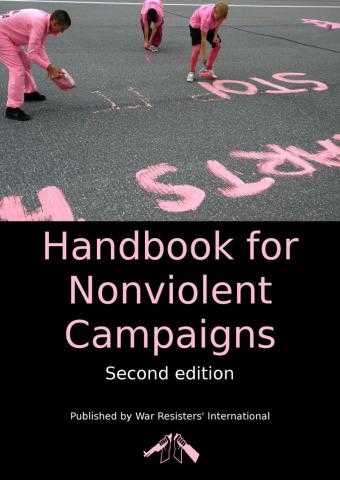
The front cover of our Handbook for Nonviolent Campaigns

Resources

Handbook for Nonviolent Campaigns

In 2014 we published the second edition of our Handbook for Nonviolent Campaigns, a book to accompany and support social change movements. The book – written by over 30 seasoned activists - has been translated into over ten languages, and several thousand copies have been sold. A wide variety of movements, campaigns, trainers and individual activists from around the world have made use of the Handbook.

The English and Spanish version of the Handbook can be bought from the WRI webshop.

The German version of the Handbook is published and sold by Graswurzelrevolution.

For information other editions/languages, please contact us at info@wri-irg.org.

Empowering Nonviolence

From April 2017, the Handbook – and lots of other content – will be available online on our new Empowering Nonviolence website. Empowering Nonviolence allows users to browse the content of the Handbook, helping to make activists and movements more effective in their campaigning and direct action, more strategic in their planning, and to become more sustainable, as they learn from others and share stories and ideas.

New Worlds in Old Shells

When we think of nonviolent social change we often think of protests, direct action, banners, placards, and crowds in the street. Often these actions are saying “No!”, resisting the causes of violence and war, and they are very necessary. As important though, are the communities and organisations “building a new world in the shell of the old”, saying “yes!” by putting into practise the emancipatory, nonviolent, empowering ways of working and living we hope – one day – everyone will experience. Gandhi coined the word “constructive programmes” to describe this sort of social change, and we are currently writing a new publication exploring these ideas, called New Worlds in Old Shells.

Nonviolence Training

The Nonviolence Programme is a direct response to needs expressed by activist groups for nonviolence training and resources, especially focusing on campaign strategies for nonviolent direct action (NVDA). The training tools and materials we use are designed to facilitate the groups that contact us in the processes they initiate and lead. We do not prescribe a particular way of taking action; our goal is to train and empower local nonviolence trainers, to build independent, local capacity with the groups we work alongside.

Defense of Democracy and the demonstration celebrations

Five hundred people coming from 19 countries met for the activist conference at Marc Bloch University in Strasbourg, on February 14 and 15 2009, invited by the International Coordinating Committee * «  No to war-No to NATO » and hosted by the “Collectif de Strasbourg
anti-OTAN” against NATO, to prepare the activities of the counter- summit on NATO’s 60th anniversary which will be held in Strasbourg in April 1-5.

On 3 and 4 April the heads of state and government of NATO will meet in Baden-Baden and Strasbourg to celebrate NATOs 60th birthday. We think: 60 years of NATO are not a reason to celebrate, but a reason to resist nonviolently!

Since its foundation in 1949 NATO pretended to defend the so-called free West against the allegedly aggressive communism. Would this have been the real reason for NATO's existence, NATO would have had to dissolve following the dissolution of the Warsaw Pact in 1991.

Social change doesn't just happen. It's the result of the work of committed people striving for a world of justice and peace. This work gestates in groups or cells of activists, in discussions, in training sessions, in reflecting on previous experiences, in planning, in experimenting and in learning from others. Preparing ourselves for our work for social justice is key to its success.

Shut down NATO

Placheolder image
Nonviolent action against NATO

On 4 April 1949, the North-Atlantic
Treaty Organisation was founded with the signing of the NATO treaty. On 3 and 4 April
2009, the heads of state and government of the 26 member states and
their delegations will meet in Baden Baden and Strasbourg to
celebrate NATO's 60th birthday with a NATO summit (ed.).


Citigroup, operating as Citi, is a major financial services company based in New York City. Formed by the 1998 merger of Citicorp and Travelers Group, the company employs 332,000 people around the world and holds over 200 million customer accounts in more than 100 countries.

The verdict will be slow in coming. There are several things to be optimistic, shall we say, “hopeful,” about when it comes to confronting the corruption, fraud, waste, and deceit of war profiteers – and, not surprisingly, there are many reasons to doubt that we’ll see any real change after all. I am genuinely torn as to what to expect. If Obama follows through on his positive programs, life will be much more difficult for military contractors.

Sweden has historically been a big weapons producer and exporter. For decades the Swedish peace movement have been working to end the Swedish weapons export. In spite of this the weapons export has dramatically increased lately. Since 2001 it has tripled and today Sweden is the second biggest weapons exporter in world per capita. Swedish weapons go to countries at war like the US, to dictatorships like Saudi Arabia and human rights abusers like Bahrain.

Editorial

Placheolder image

This is the last issue of 2008, which has been a year full of events related to war profiteering. We have reported on many successful actions, as again we do with this issue with the disarmament action in Sweden. The last part of the year has been dominated by the financial crisis in the world - a financial crisis in many ways due to the way the system favours big corporations whose priority it is to make their own shareholders richer and nothing else.

This article is the result of material published in the Handbook for Nonviolent Campaigns and a session on gender and nonviolence at WRI's International Nonviolence Training Exchange, in Bilbao in October 2008.

It may seem simple and obvious that we want both men and women involved in our struggles against war and injustice. However, if we want to fully utilise people's talents, energy, and insights, we need to apply gender awareness to how we organise ourselves, how we design our campaigns, and how we conduct our trainings for action.

On November 16, 1989, six Jesuit priests, their co-worker and her teenage daughter were massacred in El Salvador. A U.S. Congressional Task Force verified that those responsible were trained at the U.S. Army School of the Americas (SOA) at Fort Benning, Columbus, Georgia, USA. This is only the most notorious incident in the school's history of providing special training to Latin American military personnel known to have committed atrocities and engaged in torture.

Subscribe to Nonviolence

Stay up to date with our international antimilitarist activism.

Sign up to our email lists here